The Flamingo Incident
The Flamingo Incident, was also known as the Cuban Incident, the Cay Santo Domingo Incident, or the Sinking of HMBS Flamingo
The Flamingo Incident occurred on 10 May 1980, just under six weeks of the Defence Force's official establishment.
The Flamingo Incident was a nation building exercise which legitimized the need for a Defence Force in the minds of Bahamians at last. It proceeded to do what no Bahamian politician was able to do before. This instance of widespread national shock helped Bahamians to grasp the idea of sovereignty and independence and brought out the first instance of patriotism to the Bahamian flag.
As this incident has become known as one of the most formative and definitive events in the life of a small sovereign nation and her first line of defence, this section will present a detailed account of events and its significance in the Bahamian and Defence Force’s history.
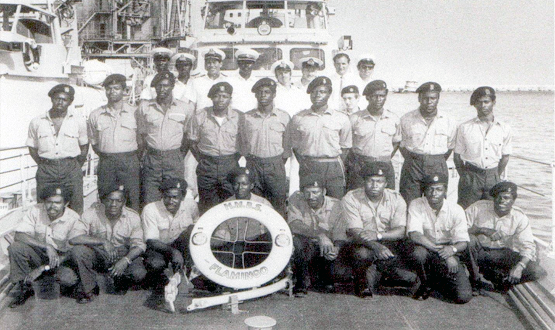
HMBS Flamingo, a 103‟ patrol vessel purchased at 4.5 million dollars from Vosper Thorneycroft had been in service for nearly two years.
Commander Amos Rolle was the Commanding Officer of HMBS Flamingo when they left Coral Harbour Base on Thursday 08 May 1980 on what should have been a routine ten-day patrol of Bahamian territorial waters. He and his 18 crew members had been tasked with stemming poaching in this particular quadrant. All remained quiet until about 1700. on Saturday 10 May, when they spotted two foreign fishing vessels, some 500 yards north of Cay Santo Domingo, engaged in fishing.
The crew of the two vessels tried to escape in a southwesterly direction. HMBS Flamingo gained on the vessels and finally caught up with them at about a mile from the Cay. The fishing vessels maintained their course and speed, even after orders to stop were passed to them over the loud hailer and warning shots fired in the air and then across the bow of their vessels. Finally, shots were directed to the bow of the vessels, bringing them to a complete stop nearly five miles away from the Cay.
Read More →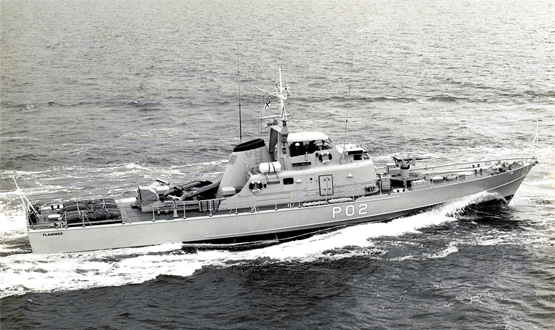
Royal Being Conferred On Defence Force
Princess Anne was invited by The Bahamas Government to confer the title “Royal” on the Bahamas Defence Force
In September 1979, Her Royal Highness Princess Anne, the daughter of Queen Elizabeth II, visited Nassau as part of The Bahamas’ Commemorative Celebrations of 250 years of parliamentary democracy. It was during this occasion that Princess Anne was invited by The Bahamas Government to confer the title “Royal” on the Bahamas Defence Force, and designate its newly occupied base as “Her Majesty’s Bahamian Ship.”
Coincidentally, one of the most important moments in the Royal Bahamas Defence Force history occurred on Saturday 29th September 1979. Coincidentally, the first House of Assembly was established and convened under the Bahama Colony’s first Royal Governor Woodes Rogers, a former sea captain and privateer.
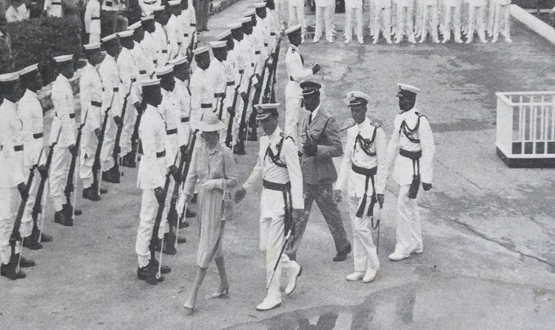
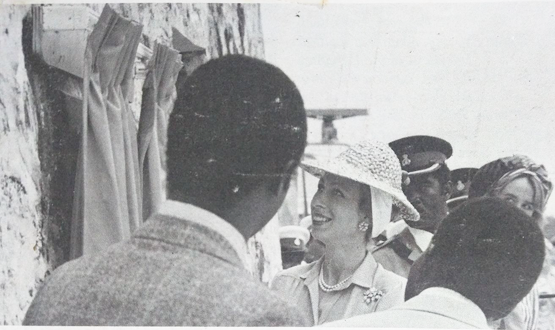
Princess Anne, herself, an honourary member of the Women's Royal Navy Service (WRNS), and her then husband, Captain Mark Phillips, unveiled a plaque designating the Base as: “Her Majesty's Bahamian Ship Coral Harbour,” and officially conferred the title “Royal‟ on the Force, making it known thereafter as the Royal Bahamas Defence Force.
Cannon John Calnan and the Reverend Ranfurly Brown prayed and blessed the ceremony while the Royal Bahamas Police Force Band played. In attendance at the event were Lady Dorothy Cash, wife of the Governor General, the late Gerald Cash, the Prime Minister of The Bahamas and the Minister of Defence, the late Lynden Pindling and Mrs. Marguerite Pindling (now former Governor General of The Commonwealth of The Bahamas), former Minister of Health, Perry Christie (now former Prime Minister) and his wife, Mrs. Bernadette Christie, the then Minister of Youth, Sports and Community Affairs, Kendal Nottage, the late former Minister for Transport, Phillip M. Bethel, and former Member of Parliament for Pinedale, the late Milo Butler Jr.
Princess Anne toured the base, welcomed aboard HMBS Marlin by its Commanding Officer, Captain Leon Smith (now retired Commander Defence Force), and accepted the Royal Salute from the Honour Guard to conclude the Commissioning Ceremony.
The Royal Bahamas Defence Force became an official entity six months later in March 1980 by an Act of Parliament, with Commodore William Swinley, a Royal Navy officer on loan to The Bahamas by the British Government, as the first Commander Defence Force.
Tribute to Bahamian UN Peacekeepers
International Day of UN Peacekeepers - 29 May 2017 as proclaimed by UN General Assembly 2003 Resolution A/RES/57/129
On July 31, 1994 UN Resolution 940 authorized member states to form a Multi-National Force (MNF) under unified command and to use ‘all necessary means to bring an end to the illegal regime in Haiti and to prompt the return of the legitimate President.
On the heels of this United Nations resolution, the United States led a multinational force into Haiti on Monday, September 19, 1994 after peace talks between General Cedras and the former US President Jimmy Carter were concluded, albeit unsuccessfully. On March 31, 1995, the MNF handed over full responsibility to the United Nations Mission in Haiti (UNMIH). The MNF and UNMIH were essential in maintaining security and stability in Haiti, aiding the return to constitutional rule, assisting in the training of a new national police force and assisting in the holding of elections.
The Bahamian Government, led by Right Honorable Hubert Ingraham, promised troops but pledged that they would not set foot into Haiti until the return of President Aristide. It is thought that this proviso arose from concern for repercussions that might arise from invading another sovereign state in such close proximity to ours.
It is important to note that The Bahamas hosted the 10th annual CINSEC (Caribbean Island Nations Security) Conference in March 1994, which laid the groundwork for the deployment of CARICOM Peacekeeping Forces to Haiti. The first contingent of Bahamian troops, led by Senior Lieutenant Phillip Clarke and assisted by Senior Lieutenant Clifford Scavella, were not authorized to join the first cadre of FOREIGN troops that landed in Haiti in September. They remained at Camp Santiago in Puerto Rico, using their time to assist the British Troops with the training of members of the Bangladesh Army.
A little more than a month later in October 16, 1994, the first 35 Bahamian troops arrived in Haiti from Puerto Rico joining their fellow peacekeepers to bring the number of countries involved to 24—Antigua and Barbuda, Argentina, Austria, Bahamas, Bangladesh, Barbados, Belize, Canada, Djibouti, France, Guatemala, Guyana, Honduras, India, Ireland, Jamaica, Nepal, Netherlands, New Zealand, Pakistan, Suriname, Trinidad and Tobago, Tunisia and United States.
In total, the Royal Bahamas Defence Force contributed 141 peacekeepers attached to four separate contingent that belonged to the Caribbean Community (CARICOM) battalion and United Nations Missions in Haiti (UNMIH). The contingents were called upon to provide VIP protection, crowd control, regular foot and armoured convoy patrols, guards at seaports in overhead observation posts, synchronized training in interrogation techniques, and a host of community-related projects. They also were used as gate sentries for the Weapons and Ammunition Turn-in Stations, also called the ‘buy-back programme’. This initiative was implemented by the UNMIH as an incentive to reduce illegal weapons possession and violence and it yielded more than 800 weapons from the locals in exchange for cash. By 1995, the Bahamian contingent had amassed twenty United Nation and Overseas Campaign medals and an additional three commendations, thus distinguishing themselves in the international arena. The last Bahamian contingent left Haiti on January 25, 1996.
(Extracted from the Chronicles of the RBDF Manuscript 1976-2010 by Lt. Desiree Corneille)